
Bouldering Grades
Bouldering grades describe how hard a problem is, but the two main systems — the American V-scale and the European Font scale — use different numbers, and gyms add their own colour circuits. This guide converts between them, explains what each grade range typically means, and includes a pyramid planner to show how many problems at each grade tend to support a jump to your next project grade.
- Free to use
- No sign-up
- Runs in your browser
Grade converter and pyramid planner
Your sends
Enter how many problems you have sent at each grade to see how full your pyramid is.
Bouldering Logbook Pack
Printable bouldering logbook, Excel pyramid tracker, V-scale/Font conversion card and a four-week training plan template.
- Logbook (PDF/DOCX/XLSX)
- Pyramid tracker (XLSX)
- Conversion card (PDF)
- Training plan (PDF/DOCX)
Formats: PDF, DOCX, XLSX. Instant download after payment (link valid 72 hours, up to 5 downloads). AI-assisted: the templates were drafted with AI help and reviewed and laid out before publishing.
$5.00 USD, one-time 4 files · about $1.25 each
- Instant download
- 7-day refund
- Secure checkout by Stripe
7-day money-back guarantee. Full refund within 7 days of purchase, even after you download.
Free sample: Bouldering Logbook (PDF, 69 KB)
Full refund within 7 days — see the refund policy and license.
Free printables
Single sheets you can print right now, no sign-up. The full pack adds every sheet in one download plus the editable files.
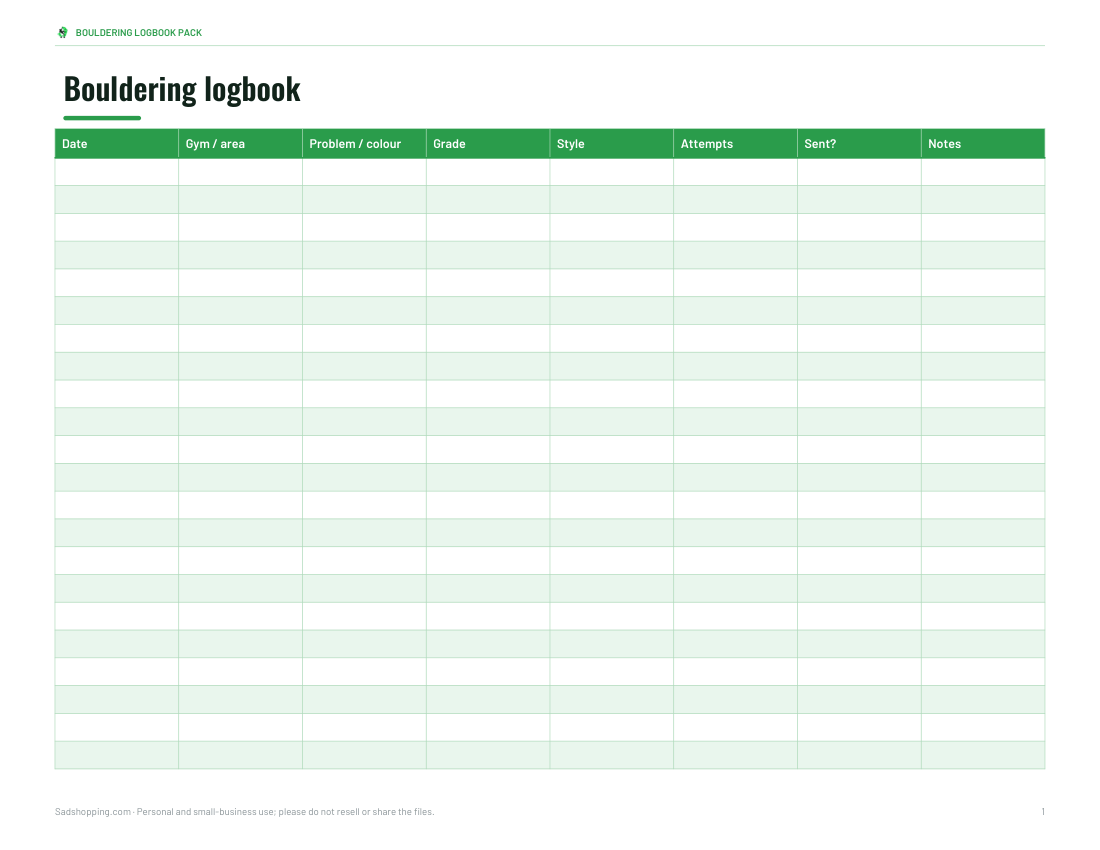
 Printable Bouldering Logbook Sheet
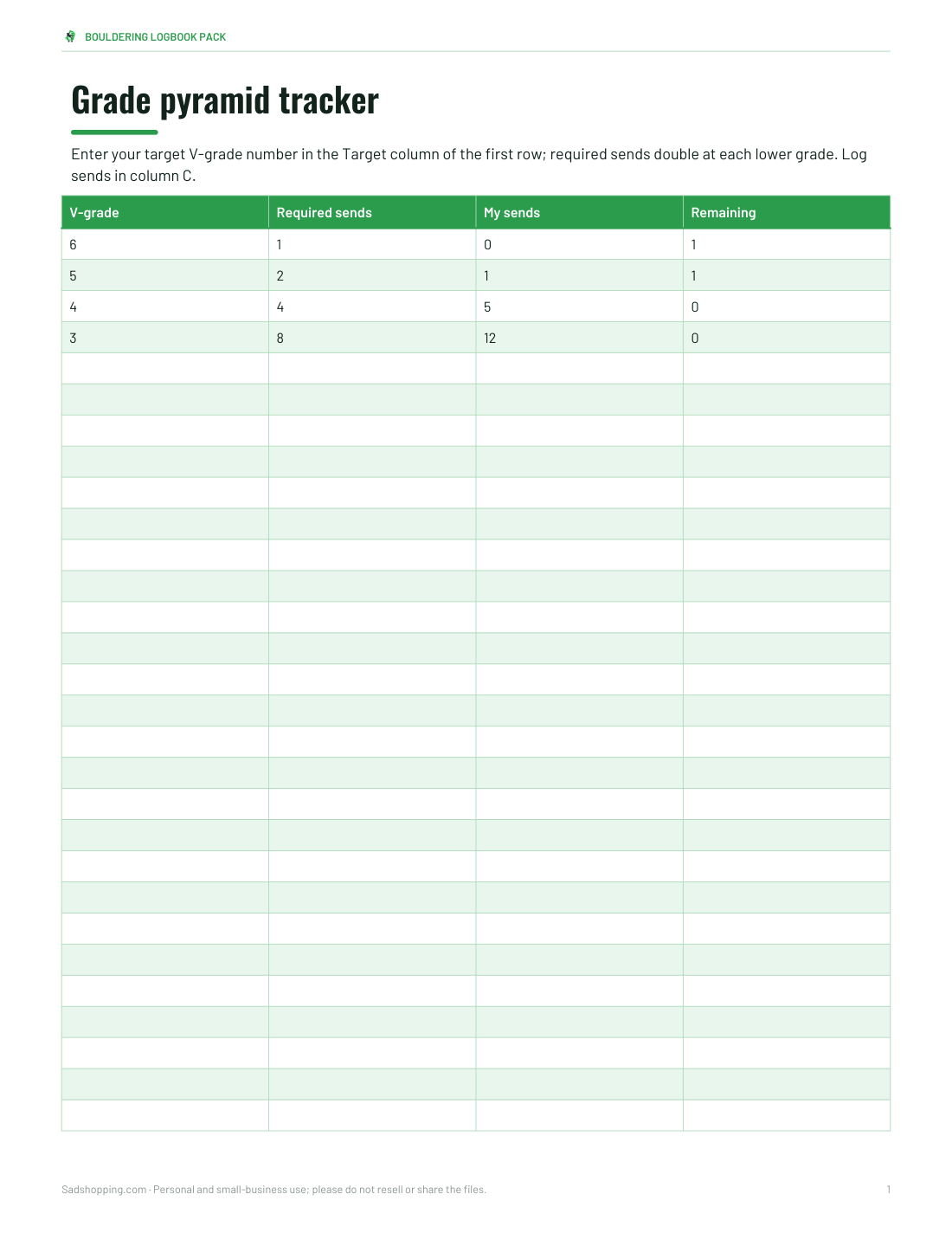
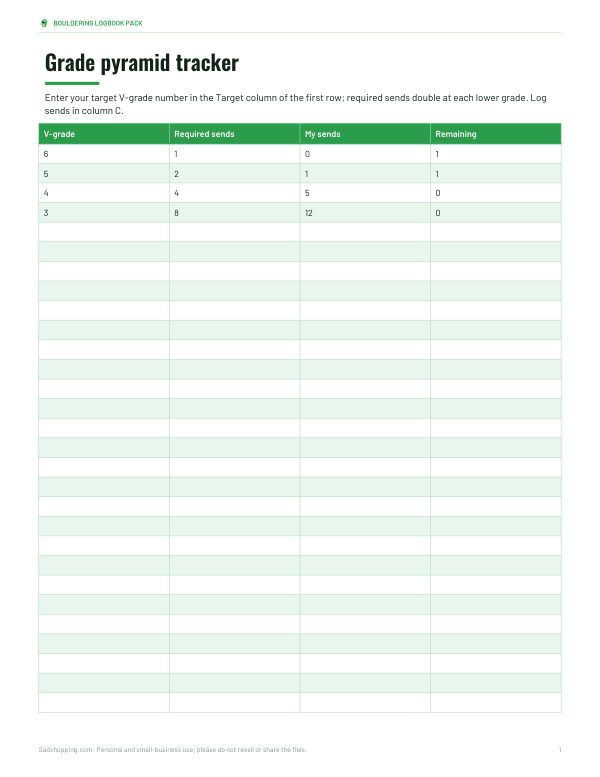 Printable Bouldering Grade Pyramid Tracker
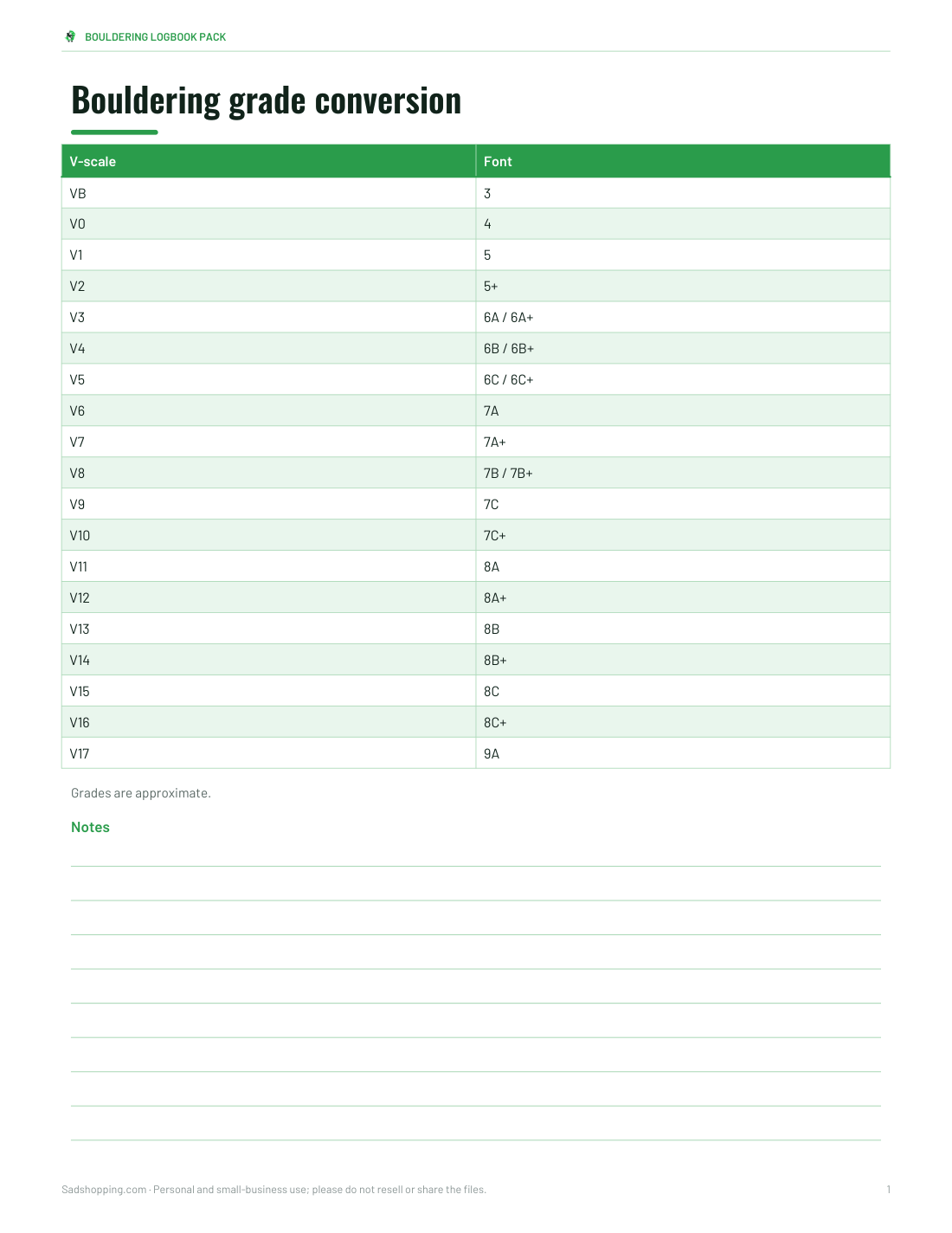
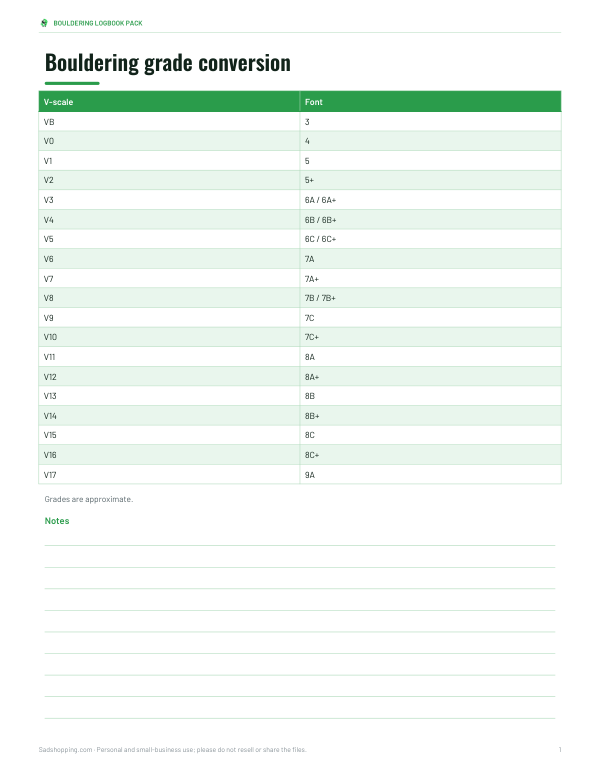 Printable Bouldering Grade Conversion Card
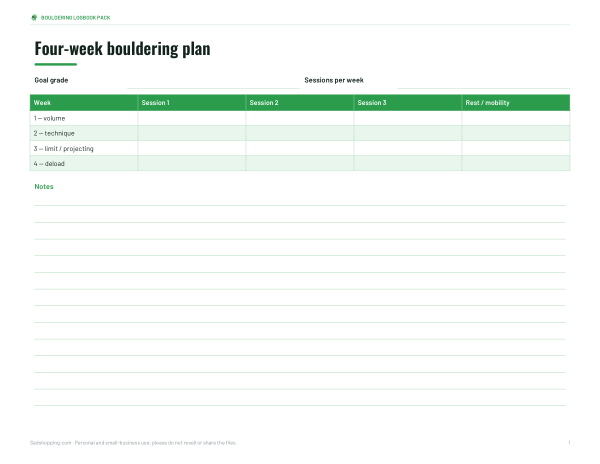 Printable Bouldering Training Plan
V-scale to Font conversion
| V-scale (Hueco) | Font (Fontainebleau) |
|---|---|
| VB | 3 |
| V0 | 4 |
| V1 | 5 |
| V2 | 5+ |
| V3 | 6A / 6A+ |
| V4 | 6B / 6B+ |
| V5 | 6C / 6C+ |
| V6 | 7A |
| V7 | 7A+ |
| V8 | 7B / 7B+ |
| V9 | 7C |
| V10 | 7C+ |
| V11 | 8A |
| V12 | 8A+ |
| V13 | 8B |
| V14 | 8B+ |
| V15 | 8C |
| V16 | 8C+ |
| V17 | 9A |
This is the conversion most commonly published by climbing gyms and guidebooks. Grades aren’t exact — a V4 may feel like 6B on one problem and 6C on another — and some sources place the boundaries slightly differently. When a range such as 6A/6A+ is given, both Font grades are commonly treated as that V-grade.
What the grades mean
| Range | Typical climber |
|---|---|
| VB–V2 (3–5+) | Beginners in their first months: big holds, learning footwork and falling |
| V3–V5 (6A–6C+) | Regular gym climbers after a year or two; technique on smaller holds and steeper walls |
| V6–V9 (7A–7C) | Advanced climbers with years of training; powerful moves and small holds |
| V10–V13 (7C+–8B) | Expert and elite climbers |
| V14–V17 (8B+–9A) | The very top of the sport; very few people have climbed V17 (9A) |
Progress varies enormously with age, body type, training and time on the wall. Many long-term recreational climbers enjoy the sport for years in the V3–V6 range.
Gym grades vs outdoor grades
- Many gyms use colour-coded circuits covering a range (for example “blue = V2–V4”) instead of exact grades.
- Gym grades are set by the gym’s route setters and can vary between gyms and between setters.
- Outdoor grades are proposed by first ascensionists and settle over time through consensus in guidebooks.
- Outdoor problems often feel harder than the same gym grade, because holds are less obvious and conditions matter.
- Style matters: slab, overhang, crimps, slopers and compression all suit different climbers.
The grade pyramid
A grade pyramid is a way to plan progression: before projecting a new grade, build a base of problems at the grades below it. A standard shape is one send at the target grade supported by two at one grade below, four at two grades below and eight at three below. The idea is that volume at slightly easier grades builds the technique and strength to make the harder grade stick, and reduces injury risk from jumping straight to limit problems. Choose the steep shape if you already have a lot of mileage, or the broad shape if you are newer and building volume.
Worked example
A climber consistently sends V4s and wants to climb V6 (7A). With the standard pyramid, the planner asks for 1 × V6, 2 × V5, 4 × V4 and 8 × V3. They enter their recent sends — 12 V3s, 5 V4s and 1 V5 — and the planner shows the base is complete at V3 and V4 but needs one more V5 before the V6 project. Converting for a trip to Fontainebleau, their V4–V5 range corresponds to about 6B–6C+.
Tips for moving up a grade
- Repeat problems you have already sent until they feel smooth — efficiency frees up strength.
- Try every problem at your level in the gym, not just the styles you like.
- Watch stronger climbers on your project and borrow their beta.
- Rest properly between hard attempts; three to five minutes is common for limit problems.
- Work on finger strength carefully and gradually — tendons adapt more slowly than muscles.
- Film your attempts to spot wasted movement and poor footwork.
Other grading systems
| System | Where | Notes |
|---|---|---|
| V-scale (Hueco) | North America, many gyms worldwide | Open-ended, VB/V0 upwards |
| Font (Fontainebleau) | Europe and much of the world | Numbers with letters and + (e.g. 6B+) |
| Dankyu | Japan | Traditional kyu and dan grades |
| B-scale | Historic | Largely replaced by the V-scale |
| Gym colour circuits | Many gyms | Ranges set by each gym |
Route climbing uses different scales — Yosemite Decimal (5.10a), French sport (6a) and UK trad — which should not be confused with bouldering grades: a 6A boulder (capital A) is much harder than a 6a sport route.
Logging your climbs
Recording sends, attempts and styles shows your real progress, highlights weaknesses such as slabs or crimps, and makes the pyramid easy to track. The optional pack includes a printable bouldering logbook, a pyramid tracker in Excel that updates as you log sends, a grade conversion card for your chalk bag and a four-week training plan template. The converter and planner on this page are free.
AI-assisted content
This page was drafted with AI assistance and reviewed before publishing. Climbing is dangerous; learn to fall safely and follow your gym’s rules.
Frequently asked questions
What is V4 in Font grade?
Usually 6B or 6B+.
What is a good bouldering grade?
It depends on experience; many regular gym climbers climb around V3–V5.
What is the hardest bouldering grade?
The top of the scale is currently V17 (9A), climbed by very few people.
Why do gym grades feel different?
Grades are subjective and set by each gym; style and hold types also affect difficulty.
What is a grade pyramid?
A progression plan with more sends at each lower grade supporting a harder target.
Is 6A bouldering the same as 6a sport?
No — Font bouldering grades use capital letters and are much harder than the same number in French sport grades.
What does VB mean?
V-basic — the easiest problems, below V0.
How long does it take to climb V5?
It varies widely; many regular climbers take one to several years of consistent climbing.